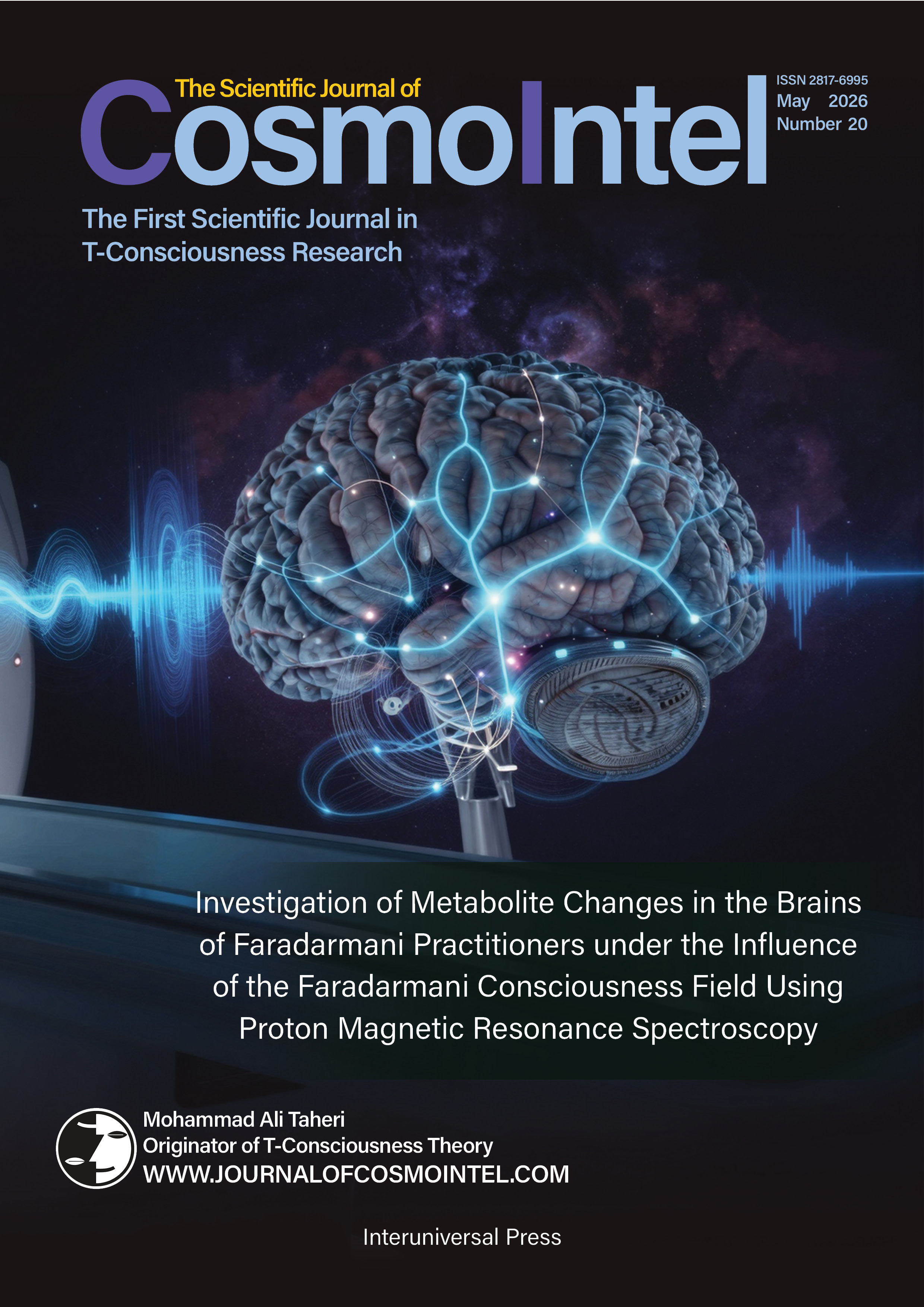
Effect of Faradarmani Consciousness Field on Brain Metabolome via H-MRS with Focus on Energy-Related Metabolites
Main Article Content
Keywords
MRS, Energy, Faradarmani Consciousness Field, Brain Metabolome
Abstract
This study investigates the effects of the Faradarmani Consciousness Field on metabolite changes, with a focus on potential alterations in energy metabolism. A previous study using fMRI revealed that certain brain regions of trained individuals, referred to as Faradarmangars, become activated or deactivated during the task state or under the influence of this Consciousness Field. Proton magnetic resonance spectroscopy (¹H-MRS), as a non-invasive method, enables the evaluation of brain function and metabolic changes under the influence of the Faradarmani Consciousness Field. Based on the obtained results, a specific reduction in the need for and consumption of ATP molecules and related metabolic pathways, along with a significant change in brain cell energetics—particularly in the activated region—can be identified. In this context, increases in lactate, ascorbate, and the macromolecule MM09 in this area may support enhanced metabolic processes recorded by fMRI. On the other hand, in the deactivated region, despite no statistically significant change, decreasing trends in glycerophosphorylcholine (GPC) and ascorbate, along with increasing trends in Pch, glutamate, and Lip13b, reflect a distinct metabolic response compared to the activated brain region. Further investigation of energy-related metabolites, particularly ATP, in the rest-task comparison under the influence of the Faradarmani Consciousness Field using phosphorus MRS is planned by the authors.